On Bullshit by Harry G. Frankfurt, 83 pages
This brief treatise on the art of bah humbag is ironically circuitous but is an interesting read all the same.
The Still Point of the Turning World by Emily Rapp // 272 pgs

Like all mothers, Emily Rapp had ambitious plans for her first and only child, Ronan. He would be smart, loyal, physically fearless, and level-headed, but fun. He would be good at crossword puzzles like his father. He would be an avid skier like his mother. Rapp would speak to him in foreign languages and give him the best education.
But all of these plans changed when Ronan was diagnosed at nine months old with Tay-Sachs disease, a rare and always-fatal degenerative disorder. Ronan was not expected to live beyond the age of three; he would be permanently stalled at a developmental level of six months. Rapp and her husband were forced to re-evaluate everything they thought they knew about parenting. They would have to learn to live with their child in the moment; to find happiness in the midst of sorrow; to parent without a future.
The Still Point of the Turning World is the story of a mother’s journey through grief and beyond it. Rapp’s response to her son’s diagnosis was a belief that she needed to “make my world big”—to make sense of her family’s situation through art, literature, philosophy, theology and myth. Drawing on a broad range of thinkers and writers, from C.S. Lewis to Sylvia Plath, Hegel to Mary Shelley’s Frankenstein, Rapp learns what wisdom there is to be gained from parenting a terminally ill child. In luminous, exquisitely moving prose she re-examines our most fundamental assumptions about what it means to be a good parent, to be a success, and to live a meaningful life.
--
This was a sad and poignant read about death and disability. I felt like I was reading a mother’s personal diary detailing her acceptance and grief over the death of her still living child.
I found Rapp’s perspectives on parenting and death to be refreshing, and it’s easy to empathize with a mother who must grieve what she loves the most. I feel like it was healthy and therapeutic for her to write this book, and I always love seeing new perspectives on death and the meaning of life. Rapp’s personal anecdotes of being disabled were also interesting to read, as well as the connection through that she could have with her son.
It was different from what I was expecting, which was a more biographical approach to her son’s life. While we did get a lot of that (I absolutely adored reading about the little things Rapp loved about her son, the language she used was hauntingly beautiful), it was more so a philosophical exploration of life itself. Rapp showcases a wisdom shadowed by unbelievable grief in a beautiful way, and I’m thankful to have experienced her perspective.
The Stranger by Albert Camus (translated by Matthew Ward) // 123 pgs

Published in 1942 by French author Albert Camus, The Stranger has long been considered a classic of twentieth-century literature. Le Monde ranks it as number one on its "100 Books of the Century" list. Through this story of an ordinary man unwittingly drawn into a senseless murder on a sundrenched Algerian beach, Camus explores what he termed "the nakedness of man faced with the absurd."
This is a book I grabbed only aware of its general “classicness”, but not of the plot. It's super short, but it packs a good punch in its length. I feel like it's made to be reread to fully take everything in, and I enjoyed how the little, seemingly irrelevant events in Part One (such as the protagonist hanging out with his girlfriend) pop up again in Part Two. I really felt for the protagonist and the themes of existentialism it presented, and the ending being one of general acceptance is nice. Risking an incorrect interpretation, I do also feel like it serves as an interesting allegory for mental illness/neurodivergence in a society that does not care to understand; how we find the "strangers" to us and, ignoring their perspective, criminalize them based on our own morality.
The Serviceberry: Abundance and Reciprocity in the Natural World by Robin Wall Kimmerer (112 Pages)

Summary: As Indigenous scientist and author of Braiding Sweetgrass Robin Wall Kimmerer harvests serviceberries alongside the birds, she considers the ethic of reciprocity that lies at the heart of the gift economy. How, she asks, can we learn from Indigenous wisdom and the plant world to reimagine what we value most? Our economy is rooted in scarcity, competition, and the hoarding of resources, and we have surrendered our values to a system that actively harms what we love. Meanwhile, the serviceberry’s relationship with the natural world is an embodiment of reciprocity, interconnectedness, and gratitude. The tree distributes its wealth—its abundance of sweet, juicy berries—to meet the needs of its natural community. And this distribution ensures its own survival. As Kimmerer explains, “Serviceberries show us another model, one based upon reciprocity, where wealth comes from the quality of your relationships, not from the illusion of self-sufficiency.”
Opinion: This is an adult non-fiction book that examines the intersection between ecology, philosophy, and economics. I've always enjoyed exploring philosophical questions and this book makes a big concept very digestible. It's a short book that is direct and even has a few illustrations. If you are interested in thinking more about how you live your life and how the world operates around you, I'd give this book a read.

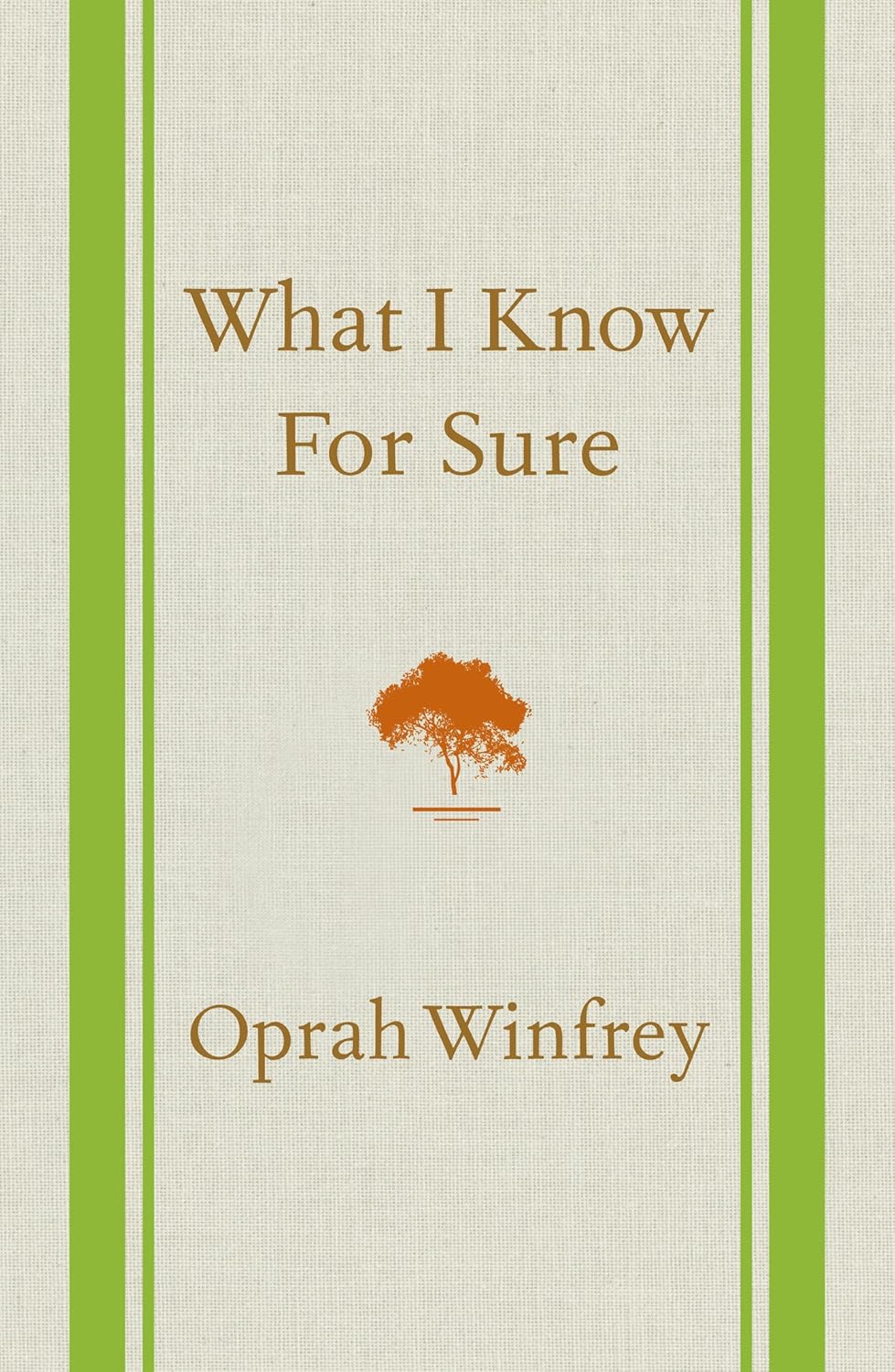 by Oprah Winfrey -- 240 pages